


 Home
 Implements
 Dealer
Quick Support
 Sales
- +91 8888200022 / +91 7744911119
- Service
- +91 8888044448
 Email
- [email protected]
Connect socially


Rabi and Boro paddy nurseries are sown between November and December and transplanted between December and February in Assam, West Bengal, Odisha, Telangana and Andhra Pradesh. The biggest risk this season is cold. Low night temperatures slow seedling growth, yellow the leaves and push transplanting late. Farmers who raise a protected mat nursery and transplant by machine finish faster, keep uniform plant spacing and avoid the labour shortage that hits every winter.
This guide explains the right timing, how to raise and protect a cold-season mat nursery, and how to prepare your field so a paddy transplanter machine works at full capacity.
When Is Rabi and Boro Paddy Transplanted in India?
The exact window depends on your state, variety and water availability. Typical windows are:
Assam (Boro): nursery in November–December; transplanting from late December to February.
West Bengal (Boro): nursery in November–December; transplanting in January–February.
Odisha (Rabi): nursery in December; transplanting from January to early February.
Telangana and Andhra Pradesh (Rabi/Yasangi): nursery in November–December; transplanting in December–January.
Always cross-check with your local Krishi Vigyan Kendra (KVK) advisory, because a cold spell can shift these dates by one to two weeks. Count back from your planned transplanting date to fix the nursery sowing date, allowing extra days for slow winter growth.
Why Does Cold Weather Make Winter Paddy Harder?
Seedlings grow slowly in winter. A mat nursery that is ready in about 15–18 days during Kharif can take 25–30 days in the Boro season. Cold nights also cause leaf yellowing, uneven seedling height and weak roots. Transplanting during a cold spell adds more stress, so seedlings take longer to establish and tiller. That is why timing and nursery protection matter more in Rabi than in any other paddy season. A healthy, well-hardened nursery is also what lets a transplanter pick up seedlings cleanly and place them without gaps or floating hills.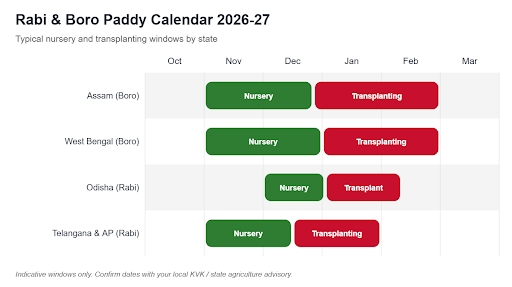
How Do You Raise a Cold-Season Mat Nursery for Machine Transplanting?
A mat nursery grows seedlings on a thin layer of soil, so the roots knit into a firm mat that slides straight into the transplanter's trays. Follow these five steps:
1. Prepare the bed: Spread a perforated polythene sheet on a level bed and add 1.5–2 cm of fine soil mixed with well-rotted FYM (about 4:1). Around 30 m² of nursery is enough for one acre.
2. Use the right seed rate: About 15–18 kg per acre for inbred varieties and 8–10 kg for hybrids, with germination above 80%. Soak the seed for 10–12 hours and incubate it until it sprouts.
3. Build a low polytunnel: Cover the bed with bamboo hoops, about 75 cm high and 125 cm wide, and transparent polythene. Seal the edges with mud to hold warmth at night.
4. Harden the seedlings: About a week before transplanting, open the tunnel for 1–2 hours a day and increase this gradually, so seedlings are fully exposed for the last two days.
5. Drain before lifting: Stop watering about 12 hours before transplanting so the mat is firm enough to cut and load.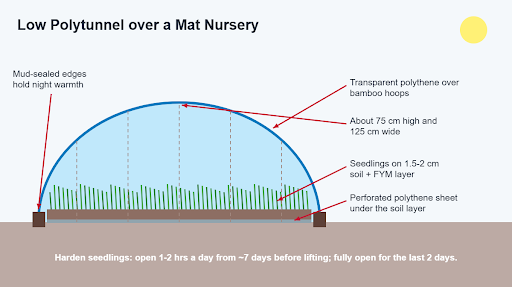
How Should You Prepare the Field for Winter Transplanting?
Puddle and level the field well, then let the soil settle for 12–24 hours so seedlings are placed at an even depth. Keep only 1–2 cm of standing water at transplanting. Avoid transplanting during dense fog or a cold spell, and wait for a sunny day instead. Plant 2–3 seedlings per hill at a shallow depth for quicker establishment.
Which Mahindra Transplanter Suits Your Farm?
Mahindra offers three transplanters, so you can match the machine to your farm size and way of working:
1.PlantingMaster Paddy 4RO (ride-on): India's first 4-row ride-on transplanter, with a 4WD hydrostatic drive, hill spacing of 16–22 cm, 5-step depth control and a 12-box seedling load. Its auto-sensing tray keeps depth uniform even on uneven puddling, making this paddy transplanter machine a strong choice for larger farms and custom hiring.
2.MP461 Walk-Behind: A light 192 kg, 4-row machine with 30 cm row spacing and a single control lever, ideal for small and fragmented plots. Explore this rice planter machine.
3.Paddy Walker 6ROW: Covers six rows per pass, with seedling spacing from 12 to 21 cm and float action that follows the field surface. See this Rice Planting Machine.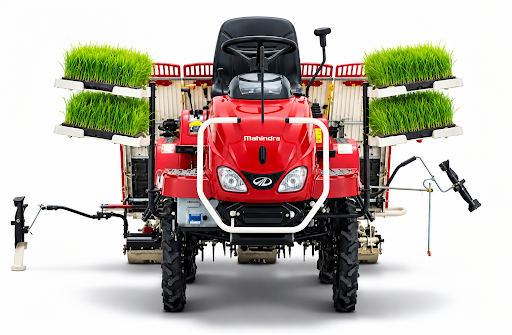
Which Machine Settings Matter Most in Winter?
Seedling stage: Load seedlings at the 2.0–3.5 leaf stage and 8–25 cm tall, the range the 4RO is built for.
Hill spacing: Many farmers choose closer spacing (16–18 cm) for short-duration varieties to make up for slower winter tillering.
Depth: Keep it shallow (2–3 cm) so roots sit in warmer surface soil.
Daily checks: Inspect the planting forks, seedling tray and feed settings before each day's work.
Frequently Asked Questions
What is the best seedling age for machine transplanting in the Boro season?
Transplant when seedlings have 2–3.5 leaves and are about 15–20 cm tall. In winter this usually takes 25–30 days from sowing, compared with 15–18 days in Kharif.
Can machine transplanting work in cold, foggy weather?
The machine works normally, but young seedlings suffer. Wait for a sunny day, drain cold water in the morning and keep a shallow water layer after planting.
Is machine transplanting cheaper than manual transplanting in Rabi?
In most areas, yes. Winter labour is scarce and costly, and a single rice planter machine replaces a large manual crew while giving a uniform plant population.
How do I choose the right transplanter for my farm?
Small or scattered plots suit a walk-behind model, while larger farms and contractors gain more from a ride-on. Compare every Rice Planting Machine in Mahindra's sowing and planting range.
Conclusion
Winter paddy rewards farmers who plan early. Sow the mat nursery on time, protect it under a polytunnel, harden the seedlings before lifting and transplant on a sunny day. Pair this with the right Mahindra transplanter, and you can finish transplanting in days instead of weeks.