


 Home
 Implements
 Dealer
Quick Support
 Sales
- +91 8888200022 / +91 7744911119
- Service
- +91 8888044448
 Email
- [email protected]
Connect socially


The best time to plant potatoes in the Indian plains is from early October to mid-November, once day temperatures drop to around 30°C and nights turn cool. Punjab, Haryana and western Uttar Pradesh plant first, followed by eastern Uttar Pradesh, Bihar and West Bengal. Planting in heat leads to seed rot and patchy sprouting, while planting too late shortens the season and exposes the crop to fog, frost and late blight.
Getting the date right is only half the job. Seed preparation, spacing and planting depth decide how many tubers each plant produces, and the right farm machinery helps you finish planting inside the short window. Here is a practical, state-wise guide for Rabi 2026.
What Is the Best Potato Planting Time in Each State?
These are the typical main-crop windows:
Punjab and Haryana: late September to early October for early crops; October to early November for the main crop.
Western Uttar Pradesh: October to early November.
Eastern Uttar Pradesh and Bihar: mid-October to mid-November.
West Bengal: late October to November.
Madhya Pradesh, Maharashtra, Gujarat and Karnataka (Rabi): mid-October to November.
Treat these as guides and follow local weather. If day temperatures are still above 30–32°C, wait a few days. In fields cleared after Kharif paddy, plan land preparation early so that planting is not delayed by wet soil or stubble.
Why Does Planting Date Affect Potato Yield?
Potato tubers form best in cool weather. Planting in heat leads to seed rot and uneven germination, which leaves gaps in the field. Late planting cuts the bulking period before harvest, so tubers stay small. In the northern plains, a late crop also faces fog, frost and a higher risk of late blight from late December onwards. In short, every week of delay beyond the ideal window can reduce the size and number of tubers you harvest.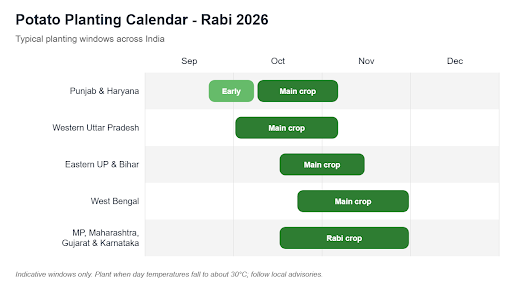
How Should You Prepare Seed Potatoes Before Planting?
Good seed preparation gives even sprouting and a uniform crop stand:
Choose certified seed: Use disease-free seed of a variety recommended for your region.
Pre-sprout the seed: Take seed out of cold storage 10–15 days before planting and keep it in a cool, shaded, airy place so it sprouts evenly.
Pick the right size: Medium, whole tubers of about 30–50 g are ideal. If you cut larger tubers, keep 2–3 eyes on each piece and let the cut surface dry before planting.
Treat the seed: Use a fungicide recommended by your local agriculture department.
Plan the seed rate: Expect 1.5–2.5 tonnes per hectare, depending on variety and tuber size.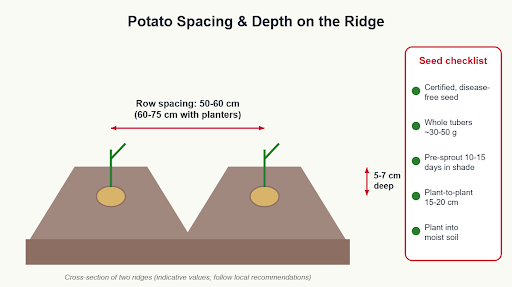
What Spacing and Depth Should You Use?
In the plains, rows are usually 50–60 cm apart, while mechanised planting often uses wider 60–75 cm ridges. Plants sit 15–20 cm apart on the ridge, with tubers 5–7 cm deep. Plant into moist soil; a pre-sowing irrigation helps, followed by a light irrigation if the topsoil dries out.
How Does Mechanised Planting Help You Plant on Time?
The planting window is short, and manual planting needs a large crew just when labour is hardest to find. A potato planter machine opens furrows, drops seed, applies fertiliser and forms ridges in a single pass.
The Mahindra PlantingMaster Potato+ is built for this job:
Two-row planting with row spacing of 61, 66, 71 or 76 cm.
Interchangeable cups from 20 to 60 mm to match your seed size.
Belt vibrator and cup-cleaning brushes for one tuber per cup, with fewer misses and doubles.
500 kg seed hopper and 130-litre fertiliser tanks for fewer refill stops.
Planting depth up to 9 inches and adjustable ridgers for well-formed ridges.
About 4,000 m² per hour at 3–5 km/h.
Mahindra reports that farmers using the Potato+ have seen 10–20% higher yields, thanks to accurate seed placement and uniform ridges.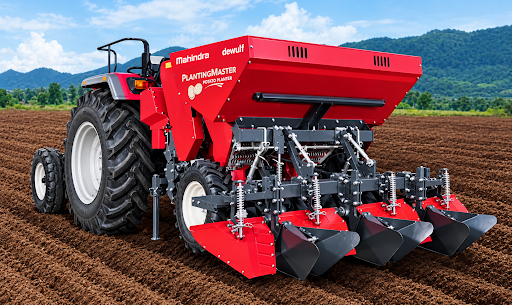
Planter Settings Checklist Before You Start
Match cups to seed grade: Use smaller cups for 30–40 g seed and larger ones for bigger tubers.
Set row spacing: Match it to your variety and tractor wheel track.
Calibrate fertiliser: Run a short test strip and check the output.
Hold a steady speed: Stay at 3–5 km/h, because higher speeds cause misses and doubles.
Check covering and ridging: Make sure tubers are fully covered and ridges are uniform.
Clean daily: Remove soil and sprouts from the cups and brushes after each day's work.
Frequently Asked Questions
What is the last date to plant potatoes in North India?
In most of the northern plains, aim to finish main-crop planting by mid-November. Later plantings can still yield, but tubers get less time to bulk and face a higher risk of frost and late blight.
Should I irrigate before planting potatoes?
Yes. Plant into soil with good moisture. A pre-sowing irrigation, followed by a light irrigation if the soil dries, supports uniform sprouting.
How many acres can the Potato+ plant in a day?
The Potato+ covers about 4,000 m² per hour, roughly one acre, at 3–5 km/h. Daily output depends on field size, turning time and refilling, so plan your seed supply in advance. Learn more about this potato planter machine.
Conclusion
Plant when the weather turns cool, use pre-sprouted certified seed and set your planter correctly before you enter the field. These three steps protect your crop stand and your yield. Explore Mahindra's complete range of farm machinery to mechanise every stage of your potato season.