


 Home
Home
 Implements
 Dealer
Quick Support
 Sales
Sales- +91 8888200022 / +91 7744911119
- Service
- +91 8888044448
 Email
Email- [email protected]
Connect socially


Heavy rain can turn a ready-to-sow field into a muddy, uneven mess within hours. Water may collect in low-lying patches, soil can become compacted, bunds may weaken and the next sowing window can start looking dangerously close. For Indian farmers, recovering quickly matters but rushing a tractor into saturated soil can create another problem. This guide explains what to check first, when to use farm machinery, which land-preparation implements can help, and how to get the field ready again without unnecessary passes.
1. Start With Water: Don't Till a Field That's Still Saturated
The first step after heavy rainfall is not ploughing. It is drainage.
Walk around the field and identify where water is standing. Check low-lying areas, damaged field bunds, blocked outlets and places where runoff has collected. If water is still stagnant, give it a route to leave the field wherever practical and safe.
This is not a small issue. ICAR reports that waterlogged saline soils affect about 4 million hectares in India's arid and semi-arid alluvial north-western states, with more than 1 million hectares each affected in coastal and black-cotton-soil regions.
ICAR has also documented a case where 150 mm of rain fell in a single day, completely submerging a rice crop. A drainage-cum-recharge structure helped reduce flood volumes and saved the crop in the lowest 5 hectares.
The lesson is simple: before thinking about farm machinery, first think about where the excess water is going.
2. Check the Soil Before Bringing in the Tractor
A field may look dry on top while remaining very wet underneath.
Take a handful of soil and squeeze it. If it is extremely sticky and holds together like a lump, it may be too wet for heavy tillage. If it starts breaking apart more easily, conditions may be improving.
This matters because working saturated soil can cause smearing and compaction. It can also make tyres sink deeper, increasing wheel tracks and tractor effort.
Recent ICAR guidance for waterlogged and flood-prone areas specifically emphasises proper drainage, land levelling, appropriate tillage and soil-health protection, while also warning against excessive rotavator use.
So don't follow a fixed “rain stopped = tractor starts” rule. Let the actual soil condition decide.
3. Repair the Field's Shape Before Preparing the Seedbed
Heavy rainfall does more than add water. It can move soil.
Runoff may create small channels, wash soil from one part of the field to another, expose roots or damage bunds. Before starting tillage, inspect the field for these changes.
Depending on the damage, you may need to: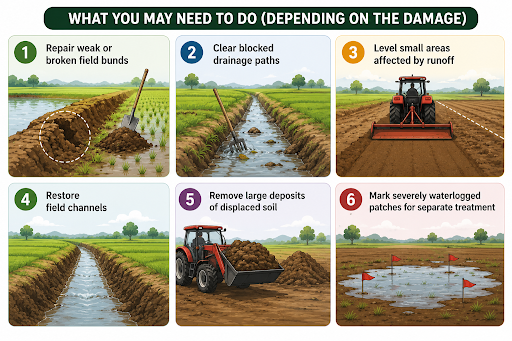
Repair weak or broken field bunds
Clear blocked drainage paths
Level small areas affected by runoff
Restore field channels
Remove large deposits of displaced soil
Mark severely waterlogged patches for separate treatment
Land shaping can also become part of long-term rain management. ICAR recommends options such as broad-bed furrow, ridge-and-furrow systems and graded surface drains in areas vulnerable to water stagnation.
This is where the right farm machinery can save considerable manual effort, particularly when damaged areas are large.
4. Choose the Implement According to the Damage
There is no single machine that should be used immediately after every heavy rain.
If the soil has simply become uneven and needs moderate preparation, a cultivator may be appropriate once the field reaches workable moisture. If hard layers have developed deeper down, a subsoiler may be considered where agronomically appropriate. If the field needs finer seedbed preparation after the soil is ready, a rotavator may be useful.
Mahindra Farm Machinery's land-preparation portfolio includes rotavators, cultivators, ploughs, disc harrows, subsoilers, power harrows, ridgers and other implements.
The company's product catalogue also describes its range as covering land preparation, sowing, crop care, harvesting, post-harvesting and material handling, with equipment designed for different crops and farm sizes.
That broader range is useful because post-rain recovery is rarely just one operation.
5. When a Cultivator Can Help
Once the soil is workable, a cultivator can help loosen the upper layer, break clods and prepare the field for subsequent operations.
For tougher conditions, the Mahindra Heavy-duty Spring Loaded Cultivator uses spring-loaded tyne assemblies and offers spacing adjustment between tynes. Mahindra specifies a working depth of up to 18–23 cm in hard soil, depending on conditions.
The important point is not to choose the heaviest implement automatically. Match the machine to the soil, tractor and actual field requirement.
6. When a Rotavator Makes Sense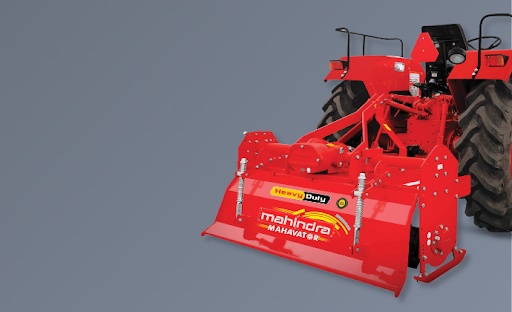
A rotavator is useful when the field needs more intensive soil finishing, residue incorporation or seedbed preparation.
For medium-to-heavy soils and tougher crop residues, the Mahavator HD is designed for wet and dry conditions and uses a multi-speed gearbox and durable Boron-steel blades. Its listed working depth is 100–140 mm, depending on soil conditions.
But remember: “wet-condition capable” does not mean “use it in any saturated field.” The soil still needs to be in a workable condition.
7. What If Heavy Rain Has Created Hard Soil Below?
Sometimes the problem is not just the surface.
Repeated traffic, natural settling or previous tillage can create compacted layers that restrict root growth and water movement. If a genuine deeper compaction problem is identified, a subsoiler may be considered instead of repeatedly pulverising the surface.
Mahindra's Sub Soiler range includes 1-, 2- and 3-tyne configurations. The company lists working depth up to 550 mm, with the actual depth depending on soil moisture and field condition. The recommended tractor-power range varies from 45–55 HP for the 1-tyne version to 65–80 HP for the 3-tyne version.
This is a good example of why choosing farm machinery should start with diagnosing the field problem rather than simply selecting the most powerful machine available.
8. Avoid the “More Passes = Faster Recovery” Trap
After losing valuable days to rain, it is natural to want to finish the field as quickly as possible.
But repeated tillage can increase fuel use, tractor traffic and soil disturbance. ICAR's 2026 farmer training programme specifically highlighted the risks of excessive rotavator use and recommended appropriate tillage, effective drainage and land levelling for waterlogged areas.
As one practical rule: do only the operation the field actually needs.
If one well-planned pass can complete the required job, there is little reason to make three passes simply because the soil looks uneven.
9. Match the Machine to Your Tractor
Before attaching any implement, check the tractor's horsepower, PTO requirements, hitch category, implement width and operating conditions.
An oversized implement can put unnecessary load on the tractor. An undersized or poorly matched machine may increase the number of passes needed.
Mahindra's range provides different configurations rather than treating every field and tractor combination alike. For example, its Mahavator HD is available in working widths from about 1.2 to 2.5 metres, with recommended tractor ranges from 35–40 HP to 65–70 HP depending on model.
That kind of matching becomes especially important when the soil is still recovering from excessive rainfall.
10. Finish With a Sowing-Ready Field, Not Just a “Worked” Field
The goal after heavy rain is not simply to make the tractor marks disappear.
The field should have suitable moisture, manageable clods, reasonable levelling and conditions appropriate for the next crop. Check whether drainage is working, whether low spots remain waterlogged and whether the soil is ready for the next operation.
As ICAR puts it, “healthy soil is the foundation of productive, profitable, and climate-resilient agriculture.”
That means recovery should focus on restoring the field, not just quickly disturbing the soil.
Mahindra Farm Machinery for the Recovery Job
A post-monsoon recovery plan may require different implements at different stages. Mahindra Farm Machinery's land-preparation range includes Mahavator, Mahavator HD, Medium Duty UM Rotavator, Heavy Duty UH Rotavator, Rigid Tyne Cultivator, Heavy-duty Spring Loaded Cultivator, Sub Soiler, Disc Harrows, Power Harrow, Ridgers and ploughs, among others.
Just as importantly, the support doesn't stop when the implement leaves the dealership. Mahindra says its after-sales network provides access to spares and servicing, while its service offering includes routine checks, service camps and door-to-door service vans.
So, when choosing farm machinery for monsoon recovery, look beyond the implement itself. Consider the soil condition, tractor compatibility, operation required, number of passes and the support available after purchase.
Heavy rain may have set your field back, but the recovery process does not have to mean starting blindly. Drain first, assess the soil, identify the actual damage, choose the right implement and work only when the field is ready. The right sequence can help you get back toward a healthy, workable field while avoiding unnecessary stress on both the soil and the machine.